












VDB Celadon Case: In Violation to Supreme Court Precedence & Fundamental Rights?

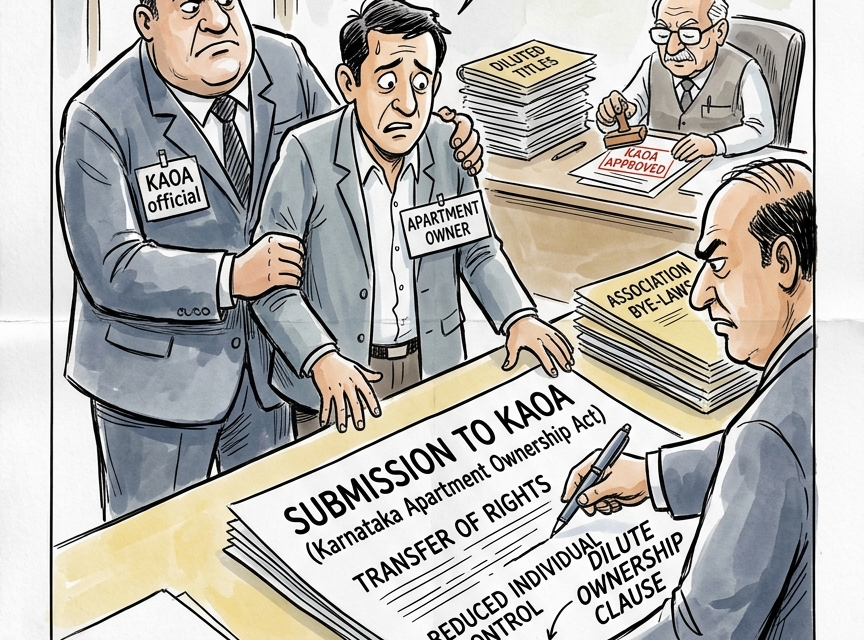
The recent order in the VDB Celadon Apartment Society Association case has sparked deep concern among legal experts, consumer activists, and apartment owners alike. The directive to form an unregistered association under the Karnataka Apartment Ownership Act, 1972 (KAOA), ignoring the Karnataka Ownership Flats Act, 1972 (KOFA) and binding Supreme Court verdicts, stands as a serious legal aberration. It undermines the fundamental rights of apartment owners and dilutes the protections guaranteed under both KOFA and the Real Estate (Regulation and Development) Act, 2016 (RERA).
The Core Issue: An Unregistered, Non-Juristic, Non-Consumer Body
The order in the VDB Celadon case directs apartment owners to constitute an association under KAOA, 1972 — even though:
- No Deed of Apartment has been registered under the Act;
- The association thus formed would be unregistered and non-juristic;
- It cannot sue or be sued, own property, or enter into valid contracts;
- It cannot represent homeowners as consumers under the Consumer Protection Act, 2019.
In effect, such a body lacks all legal capacity and legitimacy. It becomes a void instrument incapable of enforcing even basic rights of apartment owners, while builders continue to control and exploit the property under the guise of “handing over” management.
This judicial direction runs contrary to every settled principle of apartment law and consumer protection.
Ignoring KOFA 1972: The Parent Legislation Protecting Apartment Owners
The Karnataka Ownership Flats (Regulation of the Promotion of Construction, Sale, Management and Transfer) Act, 1972 (KOFA) is the parent legislation governing all multi-unit housing projects. It mandates that:
- Builders must form a co-operative society or company of flat purchasers;
- Ownership and management must be conveyed to such registered bodies; and
- The co-operative society becomes the legal entity to hold, manage, and litigate on behalf of apartment owners.
The interpretation that KOFA will remain in force until the builder executes a registered Deed of Apartment and Declaration under KAOA is too far fetched without any legal provision. KOFA & KAOA will remain till the life of the apartment in absence of any such provision. The VDB Celadon order, by forcing the formation of an unregistered association under KAOA without conveyance, short-circuits the statutory sequence. It creates a non-statutory body outside both KOFA. And KAOA, thereby depriving apartment owners of their lawful protections.

In Direct Contradiction to Supreme Court Judgments
(a) Sobha Hibiscus Owners Association vs M.D. Sobha Developers Pvt. Ltd. (2023)
The Supreme Court categorically held that KAOA applies only after the Declaration and Deed of Apartment are duly registered. It further observed that an unregistered KAOA association has no juristic status to sue or to get sued. This incapacity is serious disadvantage to manage a property. The Celadon order disregards this ruling, creating a body that the Supreme Court itself has declared as legally invalid, being unable to register the association.
(b) Aversekar & Sons Pvt. Ltd. vs Rusabh Shah & Ors. (2023)
In Aversekar & Sons, the Supreme Court reaffirmed that apartment purchasers have the right to form a co-operative society even after a Declaration under MAOA is executed. The Court clarified that the two Acts—KOFA and KAOA—operate complementarily to secure the interests of homeowners, not to exclude one another. The Celadon order, by rejecting the co-operative route and mandating an unregistered association, directly violates this binding precedent.
(c) Suman Jindal vs Adarsh Developers Pvt. Ltd. (2024)
In Suman Jindal, the Supreme Court reaffirmed that KOFA applies to all real estate developments projects with or without RERA, that the formation of a registered co-operative society is integral to completing the conveyance process. KOFA 1972 clearly mandates the formation of Cooperative Society. The Celadon decision, by bypassing KOFA and endorsing an unregistered entity, defies this clear pronouncement and weakens the enforcement of Section 17 of RERA — which mandates the transfer of title and property to a registered collective body of owners.
Violation of Fundamental Rights
The directive in the VDB Celadon case also infringes Article 19(1)(c) of the Constitution of India, which guarantees the fundamental right to form associations and co-operative societies.
By denying apartment owners the right to form a co-operative society — a juristic, registered, and democratically governed corporate body — and forcing them into an unregistered, non-legal association, the order violates both:
- The Fundamental Right to Association; and
- The Right to Property and Legal Redress under Articles 19(1)(f) and 300A (as interpreted by the Supreme Court).
The Constitution (97th Amendment) Act, 2011, further elevated the right to form co-operative societies as a constitutional right under Article 19(1)(c). Ignoring this right is not merely a procedural lapse but a constitutional breach.
Undermining RERA Section 17: Failure of Conveyance
Under Section 17 of the Real Estate (Regulation and Development) Act, 2016, the promoter is obligated to:
- Execute and register a conveyance deed transferring ownership to the apartment owners’ collective; and
- Hand over the documents and common areas to a registered legal body of purchasers.
A non-juristic KAOA association cannot receive or hold such conveyance. Thus, the Celadon order effectively frustrates Section 17, enabling builders to avoid transferring ownership — a clear violation of the statutory rights of homebuyers.
The Way Forward: Uphold Supreme Court Law and Statutory Justice
The VDB Celadon verdict is not merely a local procedural error — it is a direct affront to the Supreme Court’s binding rulings and a constitutional injustice to apartment purchasers.
To restore legality, the following must be upheld:
- Formation of a registered co-operative society under KCSA 1959 & KOFA 1972;
- Enforcement of RERA Section 17 for proper conveyance of land and building;
- Strict adherence to Supreme Court rulings in Sobha Hibiscus, Aversekar & Sons, and Suman Jindal; and
- Recognition of the fundamental right of citizens to form co-operative societies as the legitimate collective for apartment ownership and management.
The VDB Celadon case exemplifies how administrative expediency can erode the statutory and constitutional rights of citizens. By ordering an unregistered, non-juristic, and non-consumer body, the decision contradicts every principle laid down by the Supreme Court and undermines the purpose of RERA, KOFA, and the Constitution alike. Apartment owners are not mere occupants; they are stakeholders in property and law. Their rightful legal entity is a co-operative society — registered, juristic, and capable of ensuring conveyance, justice and protection of fundamental rights.




The observations clearly reiterate the direct infringement of the constitutional rights to form the Coop Society. As precisely pointed out, the judgment of VDB Celedon is a direct contradiction of the judgments of the Supreme Court of India. It is a blatant disregard for the judgments of a higher court. In view of such atrocious judgments, the lobby of powerful lobby flexes its muscles in forming illegal groups which are ultimately controlled by the builders and reap the benefits eternally. Some innocent and gullible citizens are carried away with such poor judgments, which should be stopped by highlighting the legal position. Hope your well-articulated article brings some awareness and wisdom