












DS Max Starnest Apartment Coop Society- The un-accomplished fate

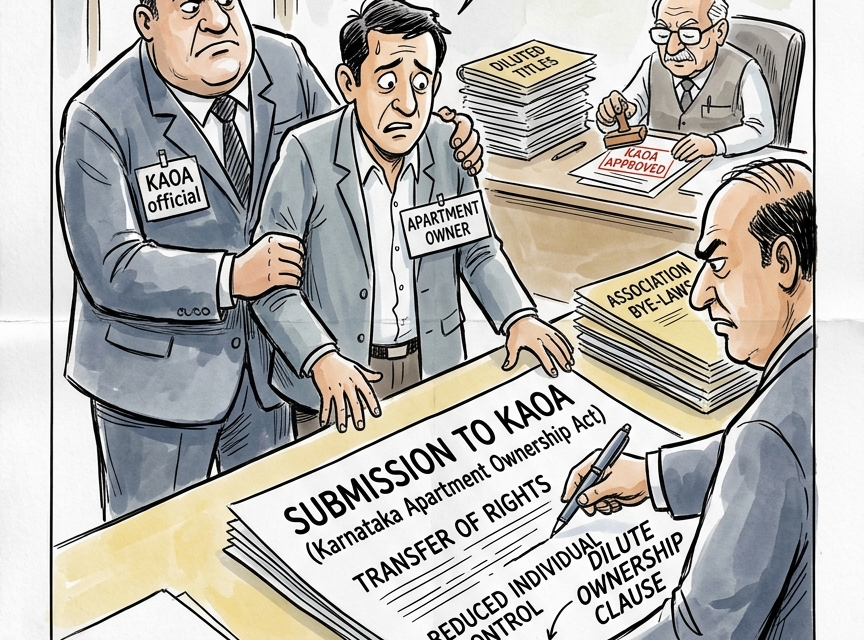
It has been almost an year since the Karnataka High Court gave an verdict against the formation of a Cooperative society to manage the apartment. The situation has worsened without being able to implement the verdict. In the DS Max Starnest apartment matter Hon’ble High Court took a restrictive view in rejecting the proposal of a proposed Cooperative Society of apartment owners. First of all the proposed Cooperative Society can not be made as a party was made as a party and tried in the Court. And the reasoning of these verdicts goes against the fundamental rights and both the legislative intent of the Karnataka Ownership Flats Act, 1972 (KOFA) and the authoritative pronouncements of the Supreme Court of India on the rights of apartment purchasers and the necessity of a juristic body as decided by the Supreme Court in following judgements.
Section 10 of KOFA requires the promoter to form a cooperative society or a company once a majority of flats have been sold. The purpose is clear:
- To create a juristic corporate body of flat purchasers.
- To ensure proper management, contracting power, and enforcement of rights.
By denying this statutory route, the DS Max verdicts weaken the very protection that KOFA intended to provide to buyers.
Supreme Court Precedents Supporting Cooperative Societies
- Suman Jindal v. Adarsh Developers (2024)
- The Supreme Court categorically applied KOFA to apartment complexes and recommended formation of cooperative societies. It emphasized that cooperative societies provide the only sustainable legal framework for management and ownership of common areas. In this case, the Hon’ble Supreme Court clearly applies the provisions of the KOFA to a residential apartment which means that the Cooperative society provision envisaged in KOFA can also be effectively applied without hesitation.
- Avasarakar & Brothers v. Rusabh Shah (2022)
- The Court held that a cooperative society can be formed even after execution of a Deed of Declaration under the Apartment Ownership Act. This directly contradicts the DS Max reasoning, which confined buyers to non-juristic associations under KAOA. The Supreme Court clarified that cooperative societies remain available and valid despite KAOA registrations.
- Nahalchand Laloochand Pvt. Ltd. v. Panchali Cooperative Housing Society (2010, 9 SCC 536)
- The Court upheld the rights of cooperative housing societies over common areas, holding that developers cannot retain control. This principle reinforces why societies must be formed – without them, builders continue to exploit ambiguities to deny handover of assets.
- Faqir Chand Gulati v. Uppal Agencies (2008, 10 SCC 345)
- The Court recognised flat buyers as consumers and builders as service providers. The cooperative society embodies this consumer collective, ensuring that consumer rights are enforceable.
- Sobha Hibiscus Vs MD Sobha Developers
- Hon’ble Supreme Court has clearly stated in its verdict that the Association formed under KAOA are not voluntary registered associations having no competence to sue or get sued. This is an handicap to own and manage any property without the capacity of a juristic person.

Why the DS Max Verdicts are Legally Unsustainable
- Violation of Fundamental Rights: Subsequent to the 97th amendment, it is the fundamental right of every citizen to form a Cooperative Society which can not be nullified under the pretext of a local law. Also under the Article 43B of the Indian Constitution is a Directive Principle of State Policy, that directs the state to promote the voluntary formation, autonomous functioning, democratic control, and professional management of co-operative societies. Indian/State Governments Departments including the Judiciary are also part of the State which are needed to promote the Cooperative Society under this direction of the Constitution.
- Contrary to Legislative Intent: KOFA expressly envisions cooperative societies as the governance structure for apartment complexes. Judicial denial of this is judicial legislation against the statute.
- Non-Juristic Associations under KAOA are Inadequate: KAOA-based associations lack juristic personality, cannot effectively contract, and expose apartment owners to risk in fulfilling banking KYC, failing with litigation requirement to sue or get sued, and not competent to sign contract for vendor management. Under its structure this KAOA associations are not equipped or defective to handle or manage the apartments legally. Supreme Court jurisprudence favours consumer-centric juristic entities.
- Violation of Consumer Rights: By disallowing cooperative societies, apartment owners are left without a corporate consumer body, contrary to Faqir Chand Gulati and DLF Universal Ltd. v. Union of India (2010), where the Supreme Court stressed the need for collective bodies to enforce consumer rights.
- Inconsistent with Federal Principles: When the Supreme Court has clarified that cooperative societies are valid even post-Declaration, High Court verdicts denying them create disharmony and judicial inconsistency.
- The Residential vs Commercial apartments arguments fail to legally justify in absence of the statute. It is wrong to interpret the section which states “mainly’ used for residential as only used for residential. Reading further in the statute, it also states that the ground floor may be used for commercial. There is hardly any apartment where the units are not used for the Commercial purposes. Under these circumstances, the limited scope of the interpretation restricts the scope of fundamental rights and the Supreme Court precedents.
- Relying on the defective Sale Deed to form and register and association under KAOA 1972 itself is defective and void under law since there is no such provision under the law itself. Relying on the erroneous Sale Deed drafted by the builders to mislead in avoiding the register juristic body of Cooperative society is incorrect leading to Otiose judgements which can not be complied as in DsMax and other cases where the associations formed are unable to register till date.
- Defective Association structure without a juristic standing to perform the legal duties of any association
Policy and Constitutional Dimensions
- Article 14 (Equality before law): Apartment owners in other states under similar Ownership Flats Acts are entitled to cooperative societies. Karnataka residents cannot be arbitrarily denied the same protection.
- Article 19(1)(c) (Right to form associations): Denying the cooperative route interferes with citizens’ right to form lawful cooperative societies for the protection of their common property.
- Directive Principles of State Policy: Promotion of cooperative societies has been recognised as a constitutional goal under Article 43B, inserted by the 97th Amendment.
The DS Max verdict err in curtailing apartment buyers’ fundamental rights. Supreme Court jurisprudence consistently upholds the formation of cooperative societies as the rightful, consumer-centric, and legally sound mechanism for apartment management. Any interpretation denying such societies directly undermines KOFA’s purpose, contradicts binding Supreme Court precedents, and leaves apartment owners vulnerable. Because of this judgement, till date the condition of the apartment is in suspended animation status since no one can form an association like that and register under KAOA. Therefore, the stronger legal position, grounded in both statute and apex court rulings, is firmly in favour of Apartment Cooperative Societies as the appropriate and mandatory governance model for both residential and commercial apartment complexes in Karnataka.



A lucid attempt to analyze the DS Max judgement, which perplexingly not based on facts but on erroneous interpretation.
Well articulated and presented by Mr. Durgekar who has understood the reality. The case itself is a erroneous representation, the facts were hidden , It also reflects on the deadly nexus between builders and banks. Hope the truth is brought forth and justice prevails thereby helping all the flat owners in Karnataka.
Dx Max Judgment has not compiled many of the constitutional provisions and seems to be delivered hurriedly. It appears that the judgement can be appealed to higher level for a fair hearing. Mr. Durgekar has elaborately discussed the issue on various angles.