











Collusive litigation and Judicial Safeguards

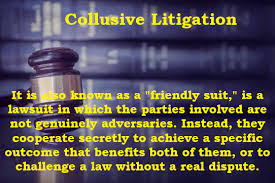
Litigation is a fundamental mechanism by which public policy and legal rights are clarified in constitutional democracies. However, legal systems can face strategic litigation, where parties file cases not solely to resolve genuine disputes, but to obtain favourable rulings that shape future law. The judicial system is founded on the adversarial process, where opposing parties present competing arguments before an impartial court. This process enables courts to test facts, law, and policy through rigorous scrutiny. However, when this foundational principle is undermined through collusive litigation, the very legitimacy of judicial outcomes is placed at risk. Collusive litigation refers to legal proceedings in which the parties are not genuinely adversarial and instead cooperate—overtly or covertly—to secure a predetermined judicial outcome. Such cases are often filed to obtain favourable declarations, interpretations of law, or precedents that can later be relied upon in subsequent litigation or administrative decision-making. Supreme Court has taken a suo moto cognizance of Collusive litigations by officials of the Bengaluru Development authority in Shivangini Bhartia Vs State of Karnataka case. This results when the Government representation is weak, silent, or support the opposite side by not filing any objections. Sometime even after government submits the objections, it may not reach the court.
Legal Context: Genuine vs Collusive Litigation
A collusive or friendly lawsuit is one in which the parties to the dispute cooperate or are not genuinely adversarial, intending to secure a beneficial judicial declaration. While rare in genuine challenges, the concept is relevant when litigants and respondents present homogenous arguments or when litigation does not meaningfully contest the law in question but seeks a declaratory outcome. A collusive lawsuit (also called a friendly suit) occurs when the parties to a case are not genuinely adversarial, but instead coordinate their positions to obtain a court ruling on a legal question they wish to settle. In such cases, the dispute may be manufactured to secure a desired legal outcome rather than resolve a real conflict. This type of litigation is generally discouraged and sometimes barred in many legal systems because it undermines the adversarial process. In constitutional democracies like India or the United States, courts require a genuine case or controversy before they can adjudicate a matter—meaning there has to be a real clash of legal interests. Collusive actions that orchestrate both sides’ arguments to “steer the court toward a predetermined outcome” risk dismissal for lack of a true dispute. When litigants strategically use both sides of a case to achieve a ruling that benefits them or their broader public policy objective, this can resemble impact or strategic litigation—an approach where the goal is broader legal change rather than merely resolving a specific dispute. Strategic litigation can be legitimate when it identifies a real dispute; it becomes problematic when the adversarial nature is feigned to secure a predetermined result. Judgments on these litigation typically find such lawsuits void as they abuse the legal process, often involving parties pretending to be adversaries to achieve a fraudulent outcome, like circumventing laws or harming third parties. Key principles include that fraud vitiates judicial proceedings and collusive actions don’t create valid rights.
A collusive suit is one where:
- There is no real dispute between the parties,
- The litigation is initiated to obtain a judicial endorsement of a desired legal position, and
- Both sides either belong to the same interest group or are controlled or influenced by the same entity.
Objectives Behind Collusive Litigation
Collusive litigation is typically employed to achieve one or more of the following objectives:
- Creation of Precedent
A favourable judicial pronouncement—especially from a constitutional court—can be cited in later cases as binding or persuasive precedent. - Circumventing Democratic or Administrative Processes
Instead of engaging with legislatures or regulators, parties may seek judicial validation of policies or interpretations. - Shielding Decisions from Future Challenge
Once a court has ruled on an issue, subsequent challenges may be dismissed on grounds of res judicata or stare decisis. - Legitimising Controversial Policies
In sensitive areas such as taxation, land acquisition, environmental regulation, or public health collusive cases can be used to legitimise contested state actions.
| Aspect | Collusive Litigation | Legitimate Strategic Litigation | |
| Nature of dispute | Artificial or sham | Real and genuine | |
| Adversarial testing | Absent or weak | Strong and contested | |
| Purpose | Predetermined outcome | Legal reform through real cases | |
| Judicial perception | Abuse of process | Lawful and often encouraged |
Precedent and Judicial Integrity
A judicial precedent gains binding force when the court thoroughly adjudicates contested issues with genuine adversarial representation. Precedents set without rigorous engagement can lead to jurisprudential confusion or be misused by subsequent litigants.
Article 141 and Binding Precedent
In India, only principles of law declared by the Supreme Court under Article 141 of the Constitution are binding on all courts. The doctrine of stare decisis ensures consistency in judicial pronouncements, but courts must ensure that decisions are grounded in genuine disputes with proper presentation of both sides.
Risks of Strategic Litigation
When litigation is orchestrated to produce a specific outcome—be it for strategic policy positioning or to manufacture jurisprudential support—the legitimacy of precedent can be challenged. Courts are increasingly mindful of such risks, as seen in judicial scrutiny of collusive suits and improper litigation.
Impact on Precedent and Rule of Law
Precedents derived from collusive litigation:
- Lack persuasive legitimacy,
- Undermine public confidence in judicial neutrality,
- Distort the development of law, and
- Risk converting courts into policy-approval bodies rather than arbiters of justice.
The doctrine of stare decisis presupposes that earlier decisions were rendered after full, fair, and adversarial consideration. Collusive litigation breaks this assumption.
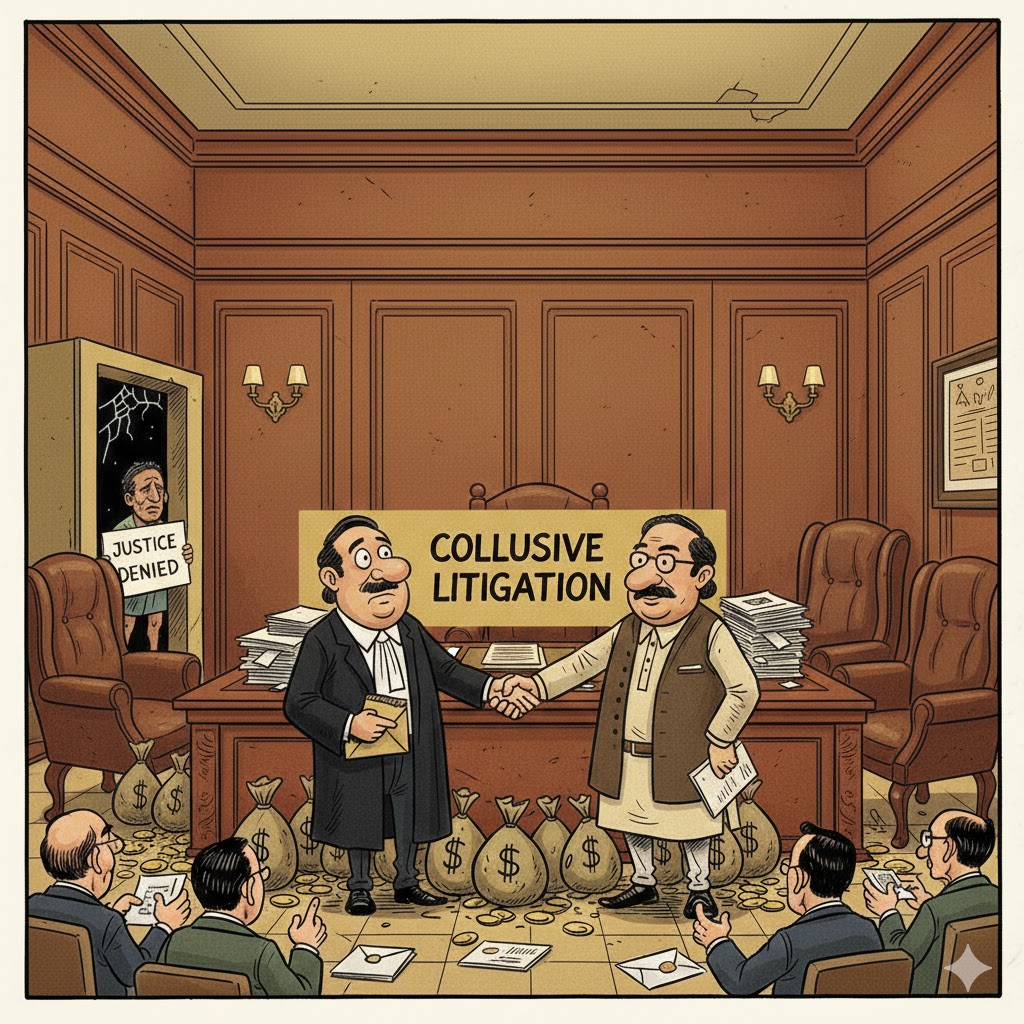
Courts worldwide have mechanisms to ensure that litigation reflects real disputes and not feigned controversies designed to manipulate legal outcomes:
Case or Controversy Requirement
In jurisdictions like the U.S., federal courts require a genuine adversarial dispute before adjudication. Courts routinely dismiss collusive suits for lack of a real case or controversy.
Judicial Scrutiny of Motives
Court may assess the substantive nature of claims and dismiss cases that appear contrived or lacking real legal injury. This prevents litigants from using courts merely to secure advisory opinions or manufactured precedents.
Collusive litigation represents a serious abuse of the judicial process. By disguising cooperation as conflict, it threatens the credibility of courts, weakens democratic accountability, and produces distorted legal precedents. Courts in India and worldwide have rightly treated such litigation with suspicion, emphasising that justice must not only be done, but must also be seen to be done. Safeguarding the judiciary from collusive practices is essential to preserving the rule of law, constitutional governance, and public trust in the legal system. While courts are powerful instruments for the legitimacy of litigation depends on real disputes and adversarial testing, not on manufactured controversies seeking strategic precedent. At the same time, judicial standards like the case or controversy requirement and scrutiny against collusive litigation guard against misuse of legal processes. Strategic litigation aimed at setting broad precedents remains valid only when rooted in real legal conflict and evidence-based arguments. It is necessary to be vigilant to ensure that litigation serves genuine dispute resolution rather than engineered legal strategy that could distort judicial precedent
By Vidyadhar Durgekar, an advocate, Ex Dy Commandant, Author & Poet with published novels, poetry and articles in Indian and international magazines.