









If Prior Environment Clearance Law is for Sustainable Development then the Ex Post facto sanction is Unsustainable?

Environmental clearances (ECs) in India form a critical part of the statutory framework to ensure sustainable development and protection of the environment. Under the Environment (Protection) Act, 1986, the Environment Impact Assessment (EIA) Notification, 2006 mandates that certain categories of industries, infrastructure, real estate, mining and other projects must obtain environmental clearance before initiating any construction or operation. The purpose is not merely procedural formality; it ensures that potential impacts on air, water, biodiversity, human health and ecology are assessed and mitigated at the planning stage itself.
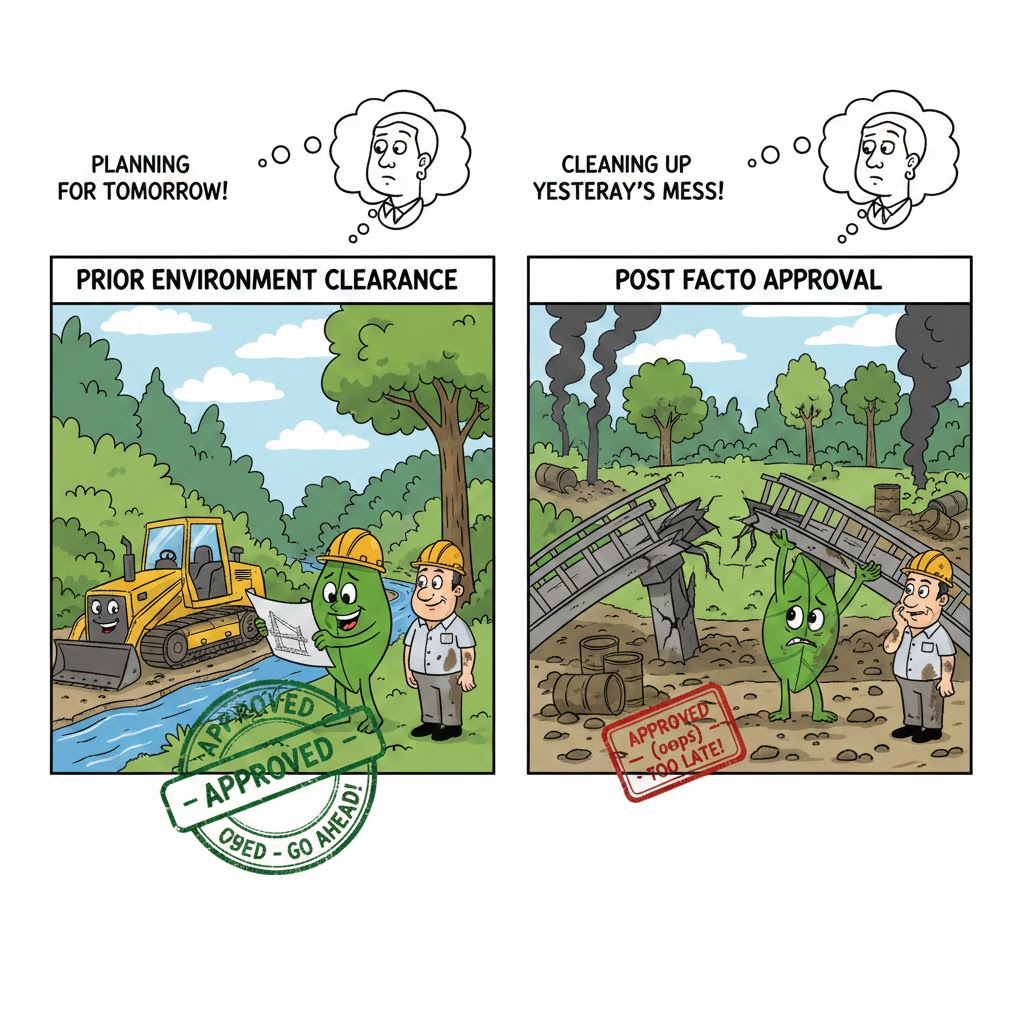
Environmental clearance is one of the most important legal tools for achieving sustainable development. It ensures that economic growth does not take place at the cost of ecological destruction or public health. The idea behind environmental clearance is simple but powerful: before a project begins, its likely impact on the environment must be studied, understood, and addressed. Sustainable development requires a balance between development needs and environmental protection. Projects such as real estate developments, industries, roads, and infrastructure permanently alter land, water systems, air quality, and biodiversity. Once construction starts, many environmental changes become irreversible. Environmental clearance acts as a preventive mechanism by requiring project proponents to plan responsibly and adopt mitigation measures before any damage occurs. The process of environmental clearance also promotes transparency and accountability. Through environmental impact assessment and public consultation, affected communities are given a voice in decision-making. This participatory approach strengthens environmental governance and ensures that development is not imposed without considering social and ecological consequences.
Importantly, environmental clearance is not meant to obstruct development but to guide and make it sustainable. When projects comply with environmental conditions at the planning stage, they become more resilient, legally secure, and socially acceptable. Ignoring this process or treating it as a formality undermines sustainable development and encourages short-term gains over long-term welfare. In essence, environmental clearance is the legal expression of sustainable development in action. It reflects the principle that development should meet present needs without compromising the ability of future generations to live in a healthy and balanced environment. Under the EIA regime, the requirement of prior clearance is central. The notification clearly states that the environmental impact assessment and public consultation processes must be completed before commencement of the project, whether it is a new development or expansion of an existing one. This prior scrutiny allows regulators to prescribe environmental management plans, mitigation measures and conditions to minimize ecological harm.
An ex post facto environmental clearance refers to a permit granted after a project has already been constructed or commenced without obtaining mandatory prior EC. In practice, these retrospective approvals arose through government notifications and office memoranda (OMs), including a 2017 notification and subsequent directives issued in 2021 and 2022, which were intended to provide a window for “violators” to seek clearance after work had begun.
Critics argue that such retroactive clearances undermine the very purpose of EIA: if a project proceeds without prior assessment, irreversible environmental damage may occur before any mitigation is considered — making the clearance itself hollow. This is especially consequential in real estate and infrastructure projects, where construction activity permanently alters land, hydrology, natural habitat and community patterns. It is like damaging the environment and then obtaining the Environment Clearance.
Supreme Court’s 2025 Ruling: Striking Down Ex-Post Facto Clearances
On May 16, 2025, a Constitution Bench of the Supreme Court delivered a landmark judgment striking down the legal basis for ex-post facto environmental clearances. The Court held that retrospective approval of projects that have already commenced without prior clearance was illegal, arbitrary and contrary to the EIA Notification, 2006. The 2017 notification and 2021 OM permitting retrospective clearances were struck down as violative of constitutional principles, including Article 14 (equalitybefore law) and Article 21 (the right to life with dignity, inclusive of a clean environment).
The court emphasised that environmental assessments are substantive safeguards intrinsic to sustainable development: they cannot be relegated to after the fact. Granting clearance after construction defeats the precautionary principle and polluter pays principle — central to environmental jurisprudence — and risks irreversible harm that cannot be undone once a project is complete. This ruling had profound implications for real estate developers as well as infrastructure projects. Without prior EC, buildings, commercial complexes, townships and other developments could not seek post-hoc legalisation merely by paying fines or fulfilling post-facto conditions. The judgment aimed to deter deliberate non-compliance with environmental norms and uphold the rule that clearance is a pre-condition to construction.
Subsequent Review and Reversal: The November 2025 Decision
However, on November 18, 2025, the Supreme Court, in CREDAI v. Vanashakti (Review Petition), revisited its earlier stance through a 2:1 majority in a review proceeding. The bench, led by Chief Justice B.R. Gavai, recalled the May 16 judgment that had struck down the 2017 notification and 2021 OM, and held that the earlier ruling suffered from “errors apparent on the face of the record”. The Court indicated that ex-post facto clearances, in exceptional circumstances, could be permissible under the Environment (Protection) Act and raised questions about prior precedents that had not been placed before the original bench. This reversal has been viewed by some environmental activists as a dilution of the precautionary principle because it effectively revived the possibility of retrospective clearances — even after construction completion — raising concerns about incentivizing non-compliance rather than enforcing strict prior assessment.
New Petition by Jairam Ramesh Against Ex-Post Facto Clearances
It is learnt that on January 23, 2026, Congress leader and former Environment Minister Mr Jairam Ramesh filed a petition in the Supreme Court challenging the legality of ex-post facto environmental clearances and seeking a complete ban on them. His contention are that such clearances are “bad in law, detrimental to public health, and make a mockery of governance”, providing an escape route for willful defaulters who bypass environmental laws and seek approval after the fact. New petition specifically targets the review judgment of November 2025 that revived the scope for retrospective clearances, urging the court to reaffirm that environmental clearance must always be obtained before commencement of development activity — not after project completion. It is contended that allowing ex-post facto EC undermines the fundamental design of the EIA regime and jeopardises ecological safeguards thatprotect communities and natural resources.
Why Prior EC Cannot Be Replaced by Retrospective Approval
There are several reasons why prior environmental clearance is essential, particularly in real estate and infrastructure projects:
1. Irreversible Environmental Harm
Once land is cleared, vegetation removed, ground altered and construction completed, the environmental impacts — such as soil erosion, altered water flows, loss of biodiversity and increased pollution — cannot be undone through later assessment or conditions.
2. Public Participation and Accountability
The EIA process includes public consultation and hearings, enabling stakeholders to voice concerns before a project begins. Retrospective clearance deprives affected communities of this opportunity for meaningful engagement.
3. Rule of Law and Deterrence
If post-hoc legalization becomes routine, project proponents may deliberately delay compliance, knowing that violations might be regularised later. This weakens regulatory enforcement and erodes environmental governance.
4. Legal Certainty for Investors and Buyers
Homebuyers and financiers rely on environmental clearances as legal assurances that a project meets statutory norms. Post-facto approvals can lead to legal disputes, project halts, and financial losses.
Environmental clearance laws in India are designed to ensure that the environmental consequences of development are assessed and mitigated before irreversible harm occurs. While the Supreme Court’s May 2025 judgment strongly reaffirmed the sanctity of prior EC by striking down ex-post facto clearances as illegal, the November 2025 review decision introduced legal uncertainty by reopening the door to retrospective approvals in exceptional cases rendering the development unsustainable. The petition filed by Jairam Ramesh in January 2026 reflects ongoing debate over this legal question, seeking to restore a clear rule that environmental clearance cannot be taken after a project has been completed — precisely because any violations may already have caused irreversible damage that cannot be “fixed” retrospectively. In the environment vs. development nexus, the law’s priority is prevention — and for environmental governance, prevention through prior assessment remains indispensable.
The Author of this article Mr Vidyadhar Durgekar is an advocate, had been an sustainability and environment assessor/auditor, Ex Dy Commandant, Author and Poet with published novels, poetry and articles