



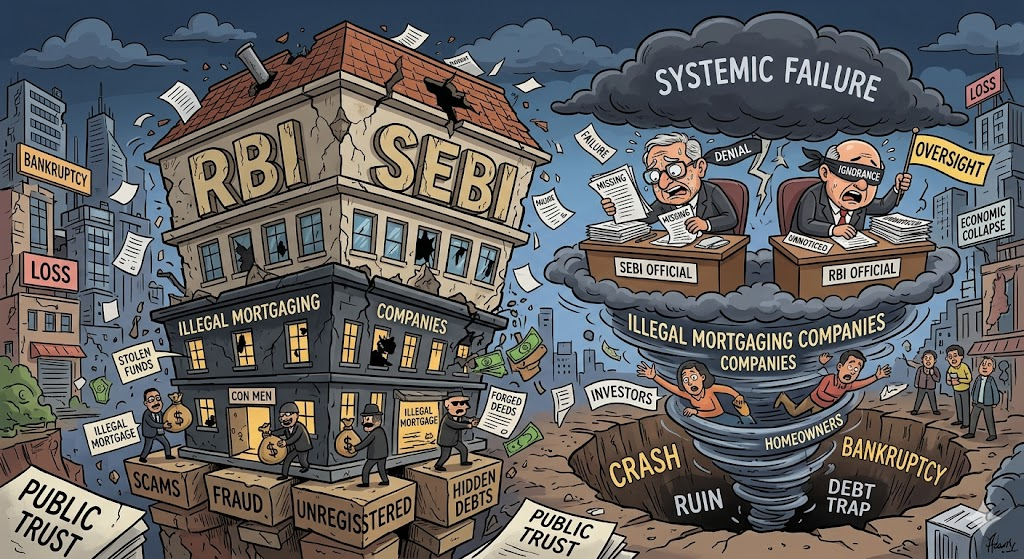










It’s no secret: corruption is deeply entrenched in our society. Publicly, we decry it; privately, we partake in it—whether to get things done or to avoid being left behind in the relentless pursuit of success. We object only when it personally harms us. Otherwise, we accept it, tolerate it, and even justify it. We continue to elect leaders with known records of corruption, expecting them to eliminate the very rot they thrive on. Ironically, we depend on these same individuals to draft laws that supposedly combat corruption. What we get instead are laws that look formidable on paper but fail miserably in practice—like scarecrows that don’t scare crows.
We like to boast of our economic growth, all the while ignoring the fact that nations with lower corruption levels are growing faster and more equitably. Disillusioned by widespread graft, the Indian voter has turned to different political parties for change. Yet, these hopes are repeatedly dashed, as successive governments—regardless of their ideology—fail to curb the systemic corruption that continues to hurt the most vulnerable citizens.

According to Transparency International’s Corruption Perceptions Index 2024, India scored just 38 out of 100, ranking 96th out of 180 countries, a decline from the previous year.
Corruption in India pervades every level of governance—political, bureaucratic, judicial, and corporate. In a society where wealth often equates to respect, it’s unsurprising that many aspire to accumulate riches through dubious means, often without consequences. Some individuals amass vast fortunes over decades while maintaining seemingly spotless careers, shielded by legal loopholes and weak enforcement.
India does possess a range of anti-corruption laws, but many end up shielding the corrupt rather than punishing them. The Prevention of Corruption Act, 1988 (amended in 2018), is a prime example. Though it’s designed to punish corrupt public servants, it has largely failed to bring influential figures to justice. The same can be said for the Lokpal and Lokayuktas Act, 2013, which aimed to create independent bodies to investigate corruption at central and state levels. Despite the promise of prosecuting public officials, including ministers and MPs, the Act has produced little tangible progress.
Another law, the Whistle Blowers Protection Act, 2014, was meant to protect those who expose wrongdoing. But whistleblowers continue to face retaliation, and awareness of the law remains low. It has done little to embolden insiders to speak up. Similarly, the Benami Transactions (Prohibition) Act, 2016, which targets illicit property holdings, is riddled with enforcement challenges. Benami assets, especially in real estate, continue to flourish with impunity, often used to reward complicit officials and middlemen. Notably, the judiciary is conspicuously absent from the scope of most anti-corruption legislation, raising serious questions about the completeness of these laws.
Catching one corrupt individual or having one honest leader is not enough. The root of the issue lies in the very structure of our system. Rather than merely hunting down culprits, we must close the systemic gaps that allow corruption to flourish. In a democracy, the presumption of innocence is important—but the machinery to prove guilt must be efficient and reliable. Unfortunately, our current legal system is anything but.
Ironically, these anti-corruption laws are drafted by the very people they are supposed to regulate. As a result, they are crafted with built-in weaknesses. Highly intelligent lawmakers with little regard for integrity draft legislation more for public display than for actual reform. For example, under the Prevention of Corruption Act, prosecuting a public official often requires prior sanction from higher authorities—a major hurdle when the accused is powerful. Without this approval, investigations stall. Even when sanctioned, the burden of proof is so high that conviction becomes nearly impossible unless the bribe is caught in real-time. In today’s world of digital transactions and indirect deals, this is an unrealistic standard. The Supreme Court, in various rulings, has insisted that both the demand and acceptance of a bribe must be proven beyond a reasonable doubt. Simply recovering marked currency isn’t enough. Such evidentiary standards make convictions rare, even in seemingly open-and-shut cases.
Further compounding the problem is the political misuse of investigative agencies such as the Enforcement Directorate (ED). Often, these bodies appear to serve the interests of the ruling party rather than acting as impartial enforcers of the law. Meanwhile, the judicial process remains painfully slow. With over three crore cases pending in courts—including thousands of corruption and financial fraud cases—justice is routinely delayed and often denied.
In high-profile scams, such as the 2G spectrum case involving estimated losses of ₹1.5 lakh crore, years of legal proceedings ultimately ended in acquittals due to “lack of evidence.”
One of the root causes of India’s corruption crisis is the opaque nature of political funding. The Electoral Bonds Scheme, introduced in 2017, has made political donations largely anonymous, allowing corporations to fund political parties in exchange for favors. This quid-pro-quo setup has effectively institutionalized corruption, making it an accepted norm rather than an exception. Rather than taking steps to rectify these systemic flaws, those in power prefer endless debates and excuses about implementation hurdles. The truth is simple: the laws are flawed by design. And until the courts can effectively prosecute offenders, public trust in these laws will remain low. Perhaps most troubling is the exclusion of the judiciary from the ambit of anti-corruption legislation. While many judges are honorable, exempting an entire institution from scrutiny undermines faith in the system. If the law is to be effective, it must be applied universally.
In its current form, the Prevention of Corruption Act—and related legislation—suffers from inherent weaknesses. Political interference, poor enforcement, slow judicial processes, and a general societal acceptance of corruption have rendered these laws largely symbolic. Without a serious attempt to bridge the gap between legal ideals and ground realities, anti-corruption efforts will continue to fail. And so, the cynicism deepens. If the laws are toothless, the systems broken, and the enforcers compromised, then one might ask—are we all corrupt? If so, what’s the point of even trying? Unless this fatalistic mindset is challenged with genuine reform and collective accountability, the status quo will prevail—and the question, why worry?, will continue to haunt us.




-
-
-
-
-
-
Show CommentsGood efforts in digging out the routes of deeply spread corruption in all walk of life.Even in Karnataka lokayukta many corrupt officers are booked for their corrupt nature in collecting money from the officers.Many of our successful and so called popular leaders are facing corruption charges….
Indian anti-corruption movement, popularly known as Anna Andolan and India Against Corruption is resonating in our minds. The very political movement against corruption was usurped by Kejriwal and used for political gains, only to join the political club. It is like George Orwell’s Animal Farm.
The momentum needs to be sustained without entry into politics. Once inside the club, survival becomes the motive for which principles will be thrown in the air.
People should be more conscious that they can change a corrupt system, there are still those of us who work to overcome curruption and believe it to be possible..
Very well written by Vidyadhar and making us realise the stark reality once again. Teaching anti corruption should start from the moment a child starts learning. This has to be ingrained in our thought process. Most of us are frustrated knowing our appeal will only father dust without any resolution. Disparity between rich and poor , strength of position and its abuse making it worse and worse
In high-profile scams, such as the 2G spectrum case involving estimated losses of ₹1.5 lakh crore, years of legal proceedings ultimately ended in acquittals due to “lack of evidence.”-This is Political Vendetta….
and
The Electoral Bonds Scheme, introduced in 2017, has made political donations largely anonymous, allowing corporations to fund political parties in exchange for favors. This quid-pro-quo setup has effectively institutionalized corruption, making it an accepted norm rather than an exception-is already Decided The Hon’ble SC of India,
Dear sir u must to be added Adani Corruption also., Otherwise ARTICLE IS VERY GOOD Sir,Keep it up
Corruption has become order of the day, part of life, way of life. Its now normalized in all rungs of the Government, be it politicians or babus, and even judiciary has been in the news recently. The enormousity of the disease of corruption is evident by the fact that it’s now treated as “Cost Of Doing Business”. And (Warning) – if you don’t pay, you will have to pay a price. Price bigger than bribe.