



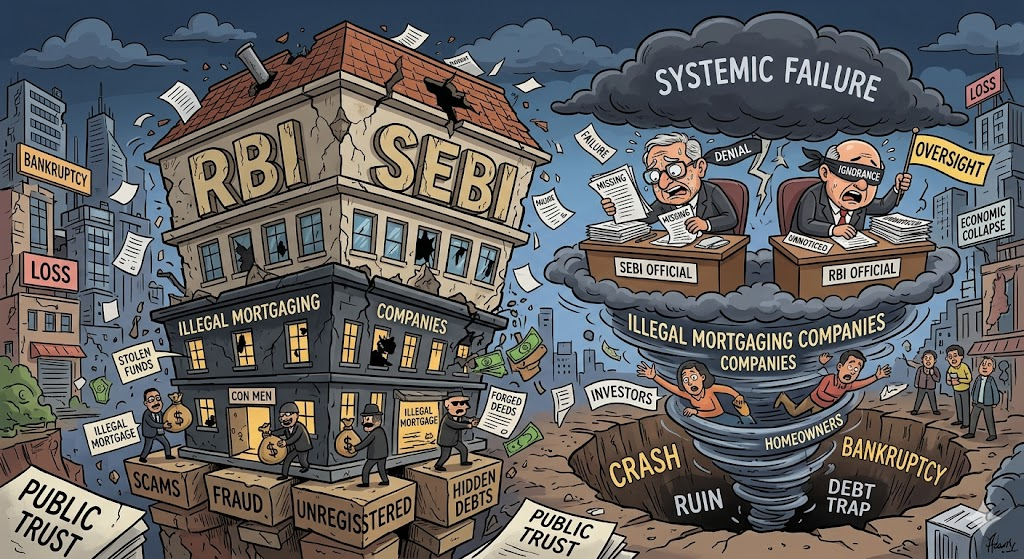










Unregistered KAOA Associations Bank Accounts are illegal? As per RBI Guidelines, Banking Laws

By Vidyadhar Durgekar, Advocate/Author/Ex Dy Commandant

The Banking Regulation Act, 1949, governs the operations of banks in India. It requires that entities opening bank accounts must have a legal status that allows them to manage funds and enter into financial transactions. Non-juristic associations may not meet these criteria, potentially leading to non-compliance with banking regulations. The Karnataka Apartment Ownership Act, 1972 (KAOA) was enacted to regulate ownership and management of apartment properties in the state. In recent years, there has been a growing trend where apartment owners form associations under KAOA, claim them as “registered associations,” and open bank accounts to collect maintenance fees and other funds. However, the Supreme Court in the Sobha Hibiscus case clarified that such associations:
- Are not registered associations,
- Are non-voluntary consumer associations,
- Are not juristic persons, and hence cannot sue or be sued in courts or consumer forums.
Despite this, many associations have been opening bank accounts by producing a Deed of Declaration (DOD) as “proof of registration.” This raises serious legal and regulatory concerns. Banks are required to open accounts only for entities that are legally competent and whose transactions can be audited and accounted for. Opening accounts for non-juristic associations violates KYC/AML provisions (Know Your Customer and Anti-Money Laundering norms under the Prevention of Money Laundering Act, 2002). Both the bank and the association could face action for breach of banking laws and AML compliance. Under the Prevention of Money Laundering Act (PMLA), 2002
- Sections 3 and 12 require entities handling large sums of money to be traceable and accountable.
- An unregistered association handling crores of rupees lacks transparency and proper accounting, making it a potential vehicle for money laundering.
- Authorities like FIU-IND and Enforcement Directorate (ED) can investigate such accounts.
The Reserve Bank of India (RBI) KYC Master Directions (2016) and banking regulations require that any entity opening a bank account must:
- Be a legal person with the capacity to enter into contracts,
- Produce valid proof of registration or incorporation, such as:
- Certificate of Incorporation (Companies Act)
- Registration Certificate of Society (Societies Registration Act)
- Registration under Cooperative Societies Act or Trusts Act
The Associations under KAOA:
- Do not have legal registration under any statute,
- DOD is not a registration certificate, and the Registration Department and Societies Department confirm they do not register such associations,
- Do not have juristic personality, so they cannot legally enter into contracts, including bank accounts.
Thus, RBI KYC norms and banking law do not permit these associations to open bank accounts in their own name. Banks opening accounts on the basis of DOD alone are violating KYC norms.
The Indian Contract Act, 1872 recognizes that only parties competent to contract can enter into legally enforceable agreements. Section 11 of the Act states that a person is competent to contract if they are:
- Of sound mind,
- Not disqualified by law, and
- Of majority age.
Crucially, a juristic person, such as a company, registered society, or trust, has legal capacity to enter into contracts. In contrast, an unregistered association or non-voluntary association does not have legal personality. Banks require a legal entity or individual to open accounts and enter into contracts. An unregistered KAOA association cannot legally be a “customer” or “consumer” for banking purposes. Attempting to sign contracts, including account opening forms, using such an association as the contracting party is not permissible under Indian law and may be considered void or illegal. The mushrooming of accounts by unregistered KAOA associations not only violates contract law but also poses serious risks of fraud and mismanagement, emphasizing the need for stricter regulatory oversight and public vigilance.
Opening a bank account using DOD as a registration document is misrepresentation. Potential consequences include:
- For the Association:
- Criminal liability under IPC Section 420 (Cheating) and Section 468 (Forgery for cheating) if funds are misused,
- Civil liability for breach of trust and mismanagement of funds.
- For the Bank:
- Violation of RBI KYC guidelines,
- Potential penalties from RBI, including fines and restrictions,
- Risk of being implicated in fraudulent activities under Banking laws,PMLA etc
To prevent unauthorized KAOA associations from opening bank accounts, the following actions are necessary:
1. Bank-Level Action
- Immediate freeze of accounts opened on the basis of DOD alone,
- Demand proper legal documents confirming the existence of a juristic person,
- Closure of accounts that cannot provide valid registration certificates.
2. Regulatory Intervention
- RBI can issue directives to banks to not accept KAOA associations without proper registration as account holders,
- Monitoring of such accounts by Financial Intelligence Unit (FIU) for suspicious transactions.
3. Legal Remedies
- Residents can file complaints in court or with EOW against associations misusing funds,
- Courts can declare such accounts illegal and order banks to close them,
- Legal action against office bearers for fraudulent misrepresentation.
- Residents can form registered association under Company Act or Cooperative Societies Act
4. Public Awareness
- Residents should verify legal registration before depositing maintenance fees,
- Associations should be encouraged to form legally recognized entities (like cooperative societies) to manage finances lawfully,
- Banks should educate customers about the need for proper registration documents.
Under Indian contract law, only legally competent individuals or entities with juristic personality can enter into enforceable contracts. Unregistered, non-voluntary consumer associations without being able sue nor get sued with legal recognition cannot lawfully act as a bank customer/consumer or sign binding contracts. The Supreme Court’s ruling makes it clear that KAOA associations, being unregistered and non-juristic, cannot open bank accounts. Banks opening accounts using DOD are violating RBI KYC guidelines, and such accounts risk misuse and legal complications. Corrective steps involve a combination of bank compliance, regulatory enforcement, legal intervention, and public awareness.

- Residents to protect their wealth must exercise vigilance and insist on proper legal documentation to protect their funds and prevent mushrooming of illegal bank accounts.
- Residents and financial institutions must be aware of this legal reality:
- Banks should refuse accounts to such associations unless they are legally registered as societies, trusts, or cooperatives.
- Residents should ensure that any entity collecting maintenance or other fees is properly registered to avoid loss of funds, misappropriation or legal disputes




Kudos to you for highlighting the significance of all the legal requirements and the consequences for non-compliance of the requirements. It is indeed an eye opener for the gullible residents who intend to form an Association who are oblivious of the requirements. Any Association in such a case need to face the consequences and is also liable for criminal action under the law.
My apartment registration done on 2015 in 1960 act and after that they didn’t renewed and audit report or any formalities done still. Now new association formed in 1960 act in our apartment no deed of declaration given by builders so we registered in 1960 act. But the previous team not ready to.handover and they elected new members without any registration . Pls guide me what to be done
Please send details to eMail [email protected].