



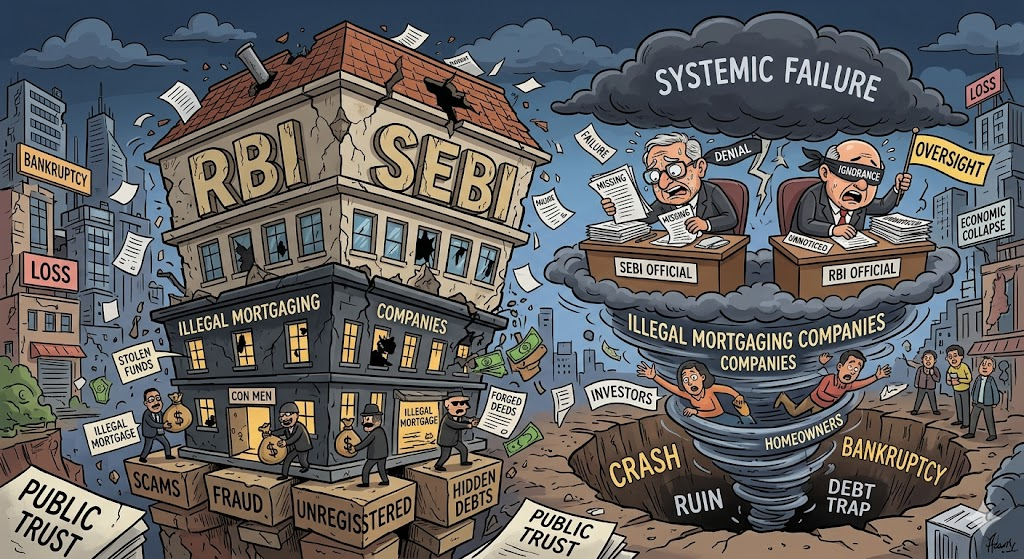
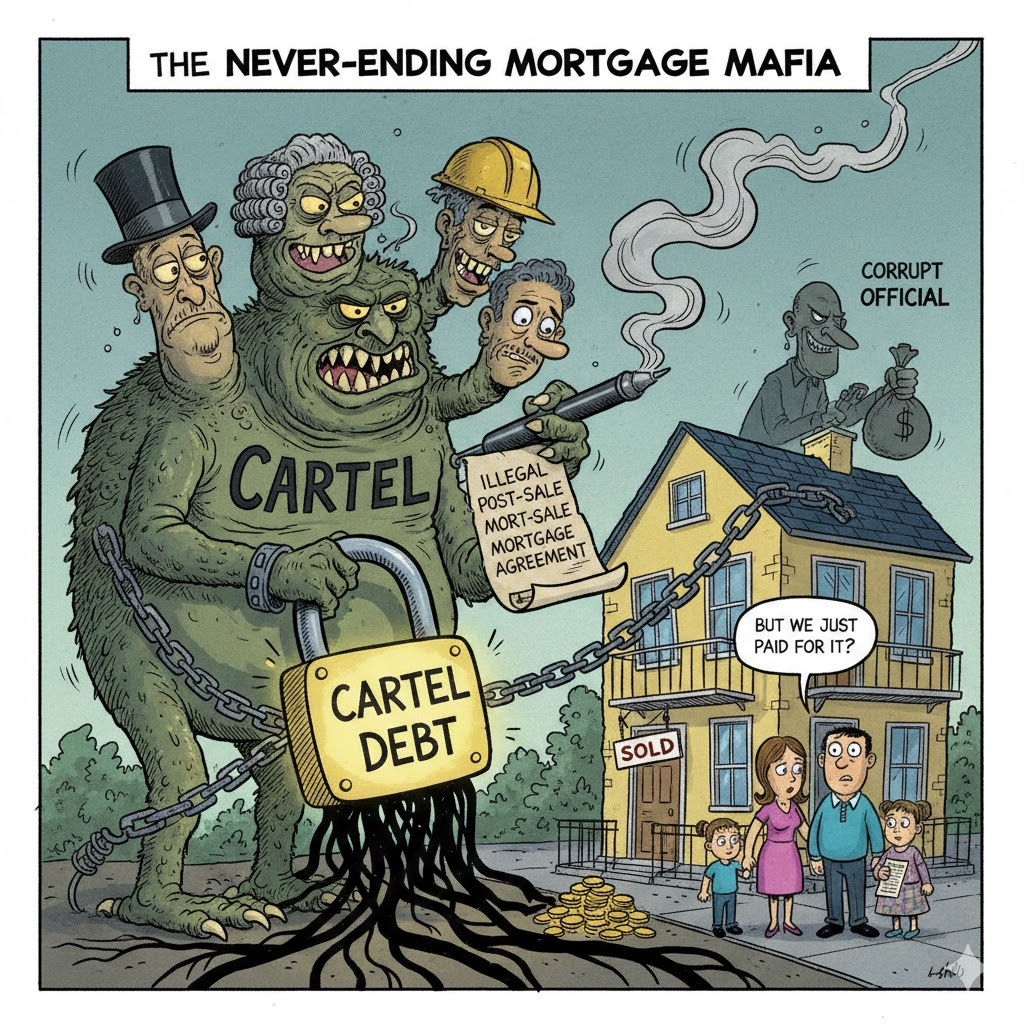









Illegal Mortgaging Of Sold Apartment Land By Seller is a CRIME

Under the Real Estate (Regulation and Development) Act, 2016 (RERA), when a builder sells flats/apartments in a project, the expectation is that the “undivided proportionate title” in the land and common areas will eventually vest with the association of apartment-owners (or the allottees). The builder/promoter must execute a registered conveyance deed in favour of the allottees (or the association) so as to transfer the land title, and ensure mutation and proper record-keeping. However, in many real-life cases, builders sell all flats (collect full sale consideration) but delay or refuse to execute the conveyance deed. They keep the land in their (or original landowner’s) name — and because on record they remain the registered owner, they then mortgage / pledge the land to banks or financial institutions to raise fresh loans, often to fund other projects or for personal use. This means that lenders may unwittingly keep charges on land underlying “sold-out” projects — land which should legally have been transferred to homebuyers. Many buyers think they’ve “bought” their flats and effectively own the land implicitly (as undivided share), but in reality the builder retains egal title and uses it as collateral — a setup ripe for fraud.
Legal and Criminal Liability: Cheating, Breach of Trust and Criminal Fraud
When a builder sells flats/apartments, collects money, but doesn’t transfer the land title — and then mortgages the same land — the following legal provisions become relevant:
- Under the Indian Penal Code (IPC), offences like cheating and dishonestly inducing delivery of property (Section 420), criminal breach of trust (Section 406 / 407) — or in the newer scheme under Bhartiya Nyaya Sanhita, 2023 (BNS) — can be invoked against a builder who misleads homebuyers and misuses the trust.
- For example, if allottees pay full sale consideration believing they will get undivided share or legal title, but builder retains title and mortgages the land (concealing that fact), that is a classic “dishonest inducement / fraudulent misrepresentation.”
- Civil remedies also exist: under the Specific Relief Act, 1963, a buyer/homebuyers’ association may file for specific performance to force the builder to execute conveyance, or cancellation of sale if there is fraud.
- Additionally, consumer-protection regime (or RERA-based adjudication) may provide compensation, refund, or interest for delay/loss.
Thus, the builder’s conduct is not just a civil violation — it may well be a criminal offence (cheating / breach of trust), with the added dimension of misuse of homebuyers’ funds.
Regulatory Remedy under RERA / Real-Estate Law
RERA (2016) — particularly Section 17 — requires that after sale, the promoter must execute a registered conveyance in favour of the allottees / association, and transfer the undivided share in common areas / land. If a builder fails to do so and mortgages or encumbers the land, that violates RERA. As recently as December 2025, the Maharashtra Real Estate Appellate Tribunal (MahaREAT) upheld a ruling against a builder who mortgaged flats after sale and held that such mortgage was invalid, ordering the builder to clear the charges, hand over possession (with valid Occupation Certificate), and pay interest for delay. The Tribunal clarified that mortgage created after the registered agreement (sale) is meaningless in law, and the burden to clear it lies on builder — not the buyer. But the Tribunal also noted that its powers are limited: it cannot order eviction or recovery; for that buyers must approach civil courts or debt-recovery / property recovery forums.
Money-Laundering / Proceeds-of-Crime Angle: Is the mortgage money “tainted”?

Given that builders often use the mortgage proceeds (raised on sold-out lands) for personal use or other projects, a legitimate question arises: can such proceeds be treated as “proceeds of crime” under the Prevention of Money Laundering Act, 2002 (PMLA), and the builder / others prosecuted for money-laundering? The purpose of PMLA is to identify “property derived or obtained, directly or indirectly, by a person as a result of criminal activity relating to a scheduled offence” and to attach / confiscate such “proceeds of crime.”
Mortgaging property that does not belong to you is a crime in India.
It can amount to multiple criminal offences under the Indian Penal Code (IPC) / Bharatiya Nyaya Sanhita (BNS):
A. Cheating – IPC 420 / BNS equivalent
If a builder mortgages land after selling flats, knowing that the title should pass to the buyers, this is dishonest concealment and fraudulent inducement. Cheating is punishable with imprisonment up to 7 years.
B. Criminal Breach of Trust – IPC 406 / BNS equivalent
When buyers pay money, the builder holds the property in trust until conveyance.
Mortgaging it for personal gain is a breach of trust.
C. Forgery / Fraudulent document – IPC 468 / 471
If the builder creates mortgage documents claiming ownership when he is not the real beneficial owner, it is forgery for the purpose of cheating.
D. Criminal Misappropriation – IPC 403
Using another person’s property for personal benefit without consent.
E. Under RERA
Once flats are sold, the land underlying the sold units legally belongs to the allottees, even if the builder keeps the title papers. Mortgage after sale violates RERA Sections 11, 17 and 19 and is an offence.
Mortgaging land belonging to buyers or allottees is a criminal offence and a statutory violation. If the mortgage was created through fraud or deception.
To understand this, we must examine the definition under PMLA Section 2(1)(u):
“Proceeds of Crime” = any property derived or obtained, directly or indirectly, as a result of criminal activity relating to a scheduled offence.”
Cheating (IPC 420) is a scheduled offence under PMLA. So if a builder commits cheating or fraud to obtain the loan, the loan amount becomes proceeds of crime.
✔ When is it “proceeds of crime”?
Money received by:
- Cheating the buyers,
- Misrepresenting ownership to the bank,
- Fraudulently mortgaging land of allottees,
- Concealing existing rights of buyers over the land,
→ is “proceeds of crime” under PMLA.
✔ Supreme Court position
The Supreme Court has repeatedly held that where property or money is received as a result of cheating, forgery or criminal breach of trust, the funds ARE proceeds of crime, even if routed through a bank.
If the mortgage was created by fraud, the loan is derived through a scheduled offence (Cheating, 420 IPC) → automatically attracts PMLA. Repayment does NOT wash away the crime. Under PMLA and IPC:
- Cheating already occurred.
- Fraudulent mortgage already occurred.
- Money obtained illegally was already used.
- Repayment does not erase the illicit proceeds origin.
Just like:
- Returning stolen money does not cancel the theft.-Criminal liability continues even after repayment.
What Authorities / Forums Can Homebuyers / Allottees Approach — and What Remedies Are Available
- Economic Offence / Money-Laundering Investigation (by ED / similar agencies): If there is evidence to show that funds raised were illicit, diverted, or the entire structure was a fraudulent scheme — ED can be approached. But given recent jurisprudence (e.g. 2025 Karnataka HC), success is uncertain unless funds and crime nexus clearly established.
- Criminal Complaint / FIR with Police / Economic Offences Wing: For cheating (IPC Section 420), criminal breach of trust (Section 406/407), misrepresentation, fraud. This applies especially when the builder intentionally deceived buyers, collected money, then mortgaged or diverted for personal use.
- Debt-Recovery / Bank / Creditors’ Action (if builder defaults on loan): If lender initiated loan using the mortgaged land, and builder defaults, lenders may proceed under SARFAESI to recover dues. Homebuyers can intervene to assert their prior claim that the land belonged (or should belong) to them.
- RERA Authority / Appellate Tribunal: File complaint under RERA (or under relevant state RERA law) for non-execution of conveyance deed, illegal mortgage/charge, non-delivery of lawful possession. As noted, tribunals may direct builder to clear mortgages, hand over OC-backed possession, pay delay interest. Example: recent 2025 MahaREAT ruling.
- Civil Court / Suit for Specific Performance or Cancellation (under Specific Relief Act): If conveyance was withheld despite payment; or if fraud / misrepresentation is proven — homebuyers / association can seek cancellation or rectification of title, declare sale void, demand refund + compensation.
Hence, while the PMLA remains a powerful weapon in white-collar economic fraud / money-laundering cases, its application in “builder mortgaging sold-out lands” is not automatic or guaranteed. Enforcement agencies must carefully prove that the property or funds are tainted.