












A Draconian Blow to Apartment Owners’ Rights in the form of New Bill

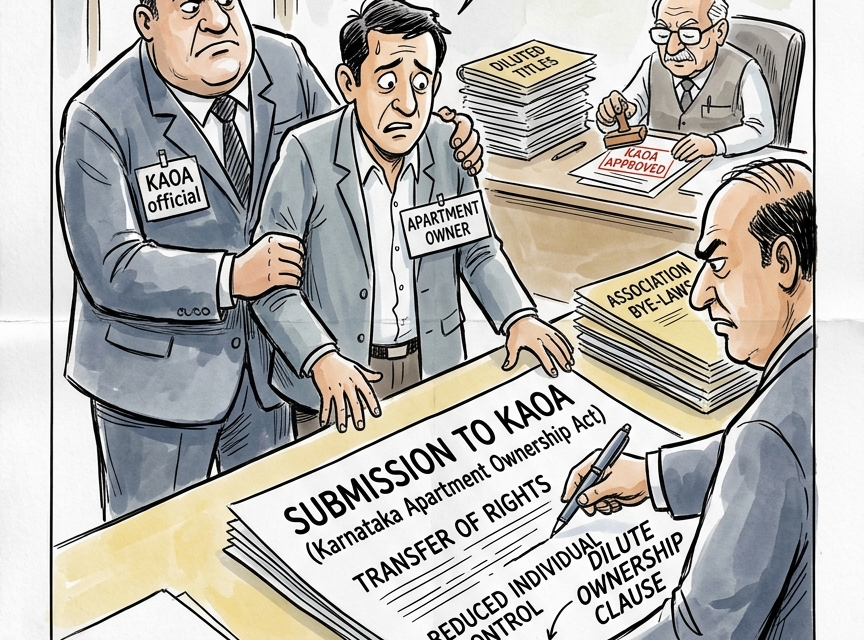
Money can create News, Money can create Opinions, Money can create Disturbance, Money can Buy Votes, Money can Buy Politicians and now Money has created a Bill. Part of the unethical Real Estate lobby is cash rich which can be used for getting things done in a corrupt society. Karnataka Government comprising of Politicians with Real Estate interests proposes another Bill supposedly for their benefit. The proposed disastrous Karnataka Apartment Ownership and Management Bill, 2026 has raised serious concerns among apartment owners, cooperative societies activists, and consumer rights advocates. Instead of strengthening the rights of home-buyers, the Bill appears to undermine decades of beneficial legislation and attempts to replace proven democratic models of Cooperative apartment management with a framework that primarily benefits the real estate lobby.
One of the most troubling aspects of the proposed legislation is the perception of conflict of interest. When governments led by ministers and influential political leaders who are themselves associated with or have significant interests in the real estate sector introduce laws governing apartment ownership and management! questions arise naturally. Public policy should be framed in the interest of citizens, not in a manner that appears to favor businesses connected with those making the laws. Laws governing millions of homeowners must be transparent, impartial, and aimed at protecting consumers rather than creating additional advantages for builders and developers. Although the Constitution does not contain an express prohibition preventing legislators from participating in law-making where they have a commercial interest,
constitutional morality, public trust doctrine, and the principle against conflict of interest require that public power be exercised solely in the public interest and not for private gain.
Legislators are expected to uphold the oath under the Third Schedule to bear true faith and allegiance to the Constitution and faithfully discharge their duties. Where Ministers or legislators who are directly engaged in, or have substantial financial interests in, the real estate business participate in framing or promoting legislation governing apartment ownership, management or builder obligations, a reasonable apprehension of conflict of interest may arise if the legislation appears to confer disproportionate benefits upon that sector.
RERA Was Introduced to Regulate, Control the Real Estate Projects to help the home buyers
For years, home-buyers across India suffered due to delays, non-completion of projects, illegal alterations, diversion of funds and other unfair practices in the real estate sector. To address these issues, Parliament enacted the Real Estate (Regulation and Development) Act, 2016 (RERA). The Act sought to regulate builders, improve transparency, protect consumers and ensure timely transfer of projects to the purchasers. A key safeguard under Section 17 of RERA requires the promoter to execute conveyance of the project in favour of the association of allottees within the prescribed period. However, many apartment owners argue that this important safeguard has not been effectively implemented in Karnataka despite the existence of the RERA regulatory authority. Sadly it is also felt that the RERA Authority is formed, appointed and reporting to the Ministers in the Government who may have interest in the Real Estate industry. This affects the governance of this esteemed institution.
New Bill Instead of Implementing Existing Laws
Instead of ensuring effective implementation of existing beneficial law of Karnataka Cooperative Society Act 1959 as being done in Gujarat and Maharashtra, the Government has proposed the disastrous Karnataka Apartment Ownership and Management Bill, 2026. Critics contend that this Bill attempts to replace rather than strengthen existing protections available under cooperative legislation, the Karnataka Ownership Flats Act (KOFA), and RERA. The proposed draconian Bill adversely impacts several important legal rights.
1. Violates the Fundamental Right to Form Cooperative Societies
- Apartment owners should retain the freedom to voluntarily establish registered cooperative housing societies, as successfully practiced in Maharashtra and Gujarat. Restricting or discouraging this model would weaken democratic self-governance. It is enshrined in the Indian Constitution under article 19(1)(c) and 97th amendment of Constitution. The Honorable Supreme Court has upheld the Fundamental Right to form Cooperative societies.
2. Violates the Ownership Rights Relating to Common Areas
- Apartment owners collectively invest in the common areas of the project. The RERA 2016 mandates the conveyance of the land to the association of allottees. The ownership, management and control of these common areas should remain with the collective body of apartment owners and should not become diluted under a different statutory framework. The provision of deemed conveyance as in Maharashtra has been ignored and rejected openly by our beloved Chief Minister in the public meeting.
3. Violates the Collective Consumer Rights
- Apartment owners are not merely individual purchasers. They are also consumers with common interests. The ability to organise collectively enables homeowners to pursue consumer remedies against unfair trade practices and builder defaults. Any law that weakens collective representation risks diminishing consumer protection. Not being a voluntary consumer association this right will not be available to agitate as a group in the Consumer forum for the liability of hundreds of crores of deficiency of service and unfair trade practice under the beneficial legislation of Consumers.
4. Eliminates the Beneficial Provision of KOFA and its Protections
- The Karnataka Ownership Flats Act contains provisions intended to regulate promoters and includes penal consequences for violations. If these protections are repealed or weakened, critics fear that accountability of errant builders may also diminish.
5. Violates and weakens the Spirit of RERA
- Rather than reinforcing the mandatory conveyance provisions of RERA, the proposed legislation may create overlapping legal structures that complicate implementation and weaken consumer safeguards envisioned under the central law. RERA 2016 clearly provides for the formation of Cooperative Societies to ensure effective Conveyance.
6. The Elimination of Affirmative action of Reservation:
- By promoting fair representation of women and other classes, reservations contribute to more inclusive and equitable development of Cooperative Societies. Even if it is not required, then to avoid Cooperative Societies on this reason is absurd and divides the society further.
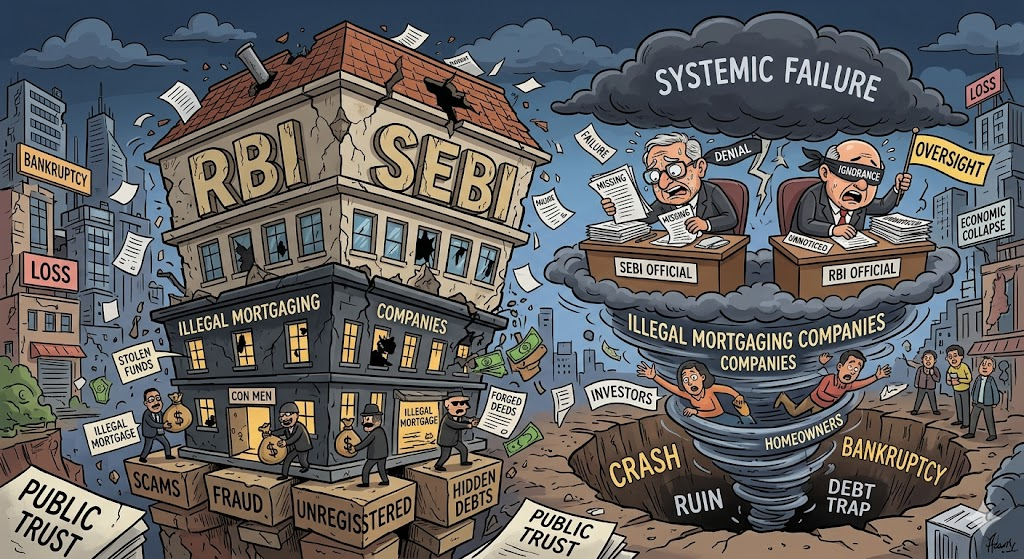
Many apartment owners also express concern that illegal construction, encroachment of lakes, obstruction of Rajakaluves, and alleged illegal mortgaging of sold properties have not received adequate enforcement attention. At the same time, authorities are often seen acting swiftly against small street vendors who depend on daily earnings for survival. Such disparities raise broader questions about priorities in urban governance and enforcement.
A Failed Experiment Should Not Be Repeated
It is known fact that the Karnataka has already experienced the shortcomings of alternative apartment management formats like KAOA. Instead of learning from successful cooperative housing models operating for decades in Maharashtra and Gujarat, the proposed Bill risks repeating an experiment that many consider ineffective. The Government should focus on implementing existing beneficial laws effectively rather than replacing them with legislation that may generate further disputes and uncertainty.
The Cooperative Apartment Model Has Proven Its Success
India’s apartment housing movement began in Mumbai, where residents transitioned from chawls to apartment living under the cooperative housing society model. Supported by cooperative legislation, residents have successfully managed their housing societies democratically for decades. Gujarat also adopted a cooperative housing framework and has demonstrated that apartment communities can be effectively governed through registered cooperative societies with legal recognition and democratic participation. These are tested and successful models. Karnataka already possessed beneficial cooperative legislation that could have enabled apartment owners to form registered voluntary cooperative societies. Instead, apartment owners were increasingly compelled to function under the Karnataka Apartment Ownership Act (KAOA), a law that critics argue primarily defines ownership rights after the same is granted by Transfer of Property Act, but does not itself provide for registration or formation of apartment associations.
According to many apartment owners and activists, this has resulted in legal uncertainty and administrative difficulties in democratic management of apartment communities.
The Way Forward
Apartment owners deserve laws that protect their investments, strengthen democratic governance, ensure transparency and hold builders accountable.
The Government should:
- Protect the constitutional freedom of apartment owners to voluntarily form registered cooperative housing societies.
- Fully implement Section 17 of RERA regarding conveyance.
- Preserve the beneficial protections available under the Karnataka Ownership Flats Act.
- Strengthen enforcement against illegal construction, fraudulent practices and violations by promoters.
- Encourage democratic, owner-controlled management rather than builder-influenced governance structures.
Conclusion

Home ownership is often the largest financial investment made by an ordinary family. Laws governing apartment ownership should therefore prioritise homeowners over commercial interests. The cooperative apartment society model has stood the test of time in states such as Maharashtra, Gujarat and other States. It empowers residents, promotes democratic management and ensures collective responsibility. The proposed Karnataka Apartment Ownership and Management Bill, 2026 deserves to be rejected to ensure that it does not weaken existing rights or reduce protections available to apartment owners. Rather than replacing successful and proven systems, Karnataka should strengthen consumer protection, faithfully implement RERA, and empower apartment owners through voluntary registered cooperative societies—the model that has demonstrated success across generations.
Number of views: 649
(Written with assistance of AI)

The Maharashtra’s existing Housing co-operative society act is the trial & tested from a longer period. It works fine and benefited all home owners. Owners redeveloped their old apartments themselves and remained the sole owner of the land.
Karnataka also need the same by just adding a chapter in co-op society act as available for milk societies, credit societies fisheries, silk societies etc.
It’s the strongest legal framework available for apartments also.
attempt to come out with another act KAOMA
WITHOUT
Strictly ENFORCING existing
ACTs. RERA KOFA KCSA & forming Coop
Societies for 4200 completed APTs & 5200
Dropped / delayed without extension
/ still not completed ongoing projects
Risking 122 Lac Cr investment @ mot CONVEYING
35.000 Acres of Allottees common areas
(Land, buildings, club hoise, Club house & amenities)
IS A-Diversion tactics
EOFORCEMENT RERA KOFA KCSA & fundamental rigjts
Meedes
NO KAOMA
Which is
Anti-constitutional
Anti citizen
Anti RERA KOFA KCSA &
Coop
Depriving 18 L+ buywrs
Fundamental Rights
Property Title Ownership Rigjts
Litigation Rigjte
Management rights
Reservation rights
INTENTION of such bill itself is questionable in the first
Place
KAOMA os REDUNDANT REPRESSIVE OPPRESSIVE