













A CRITICAL ANALYSIS WITH SPECIAL REFERENCE TO APARTMENT ASSOCIATIONS UNDER KAOA, 1972
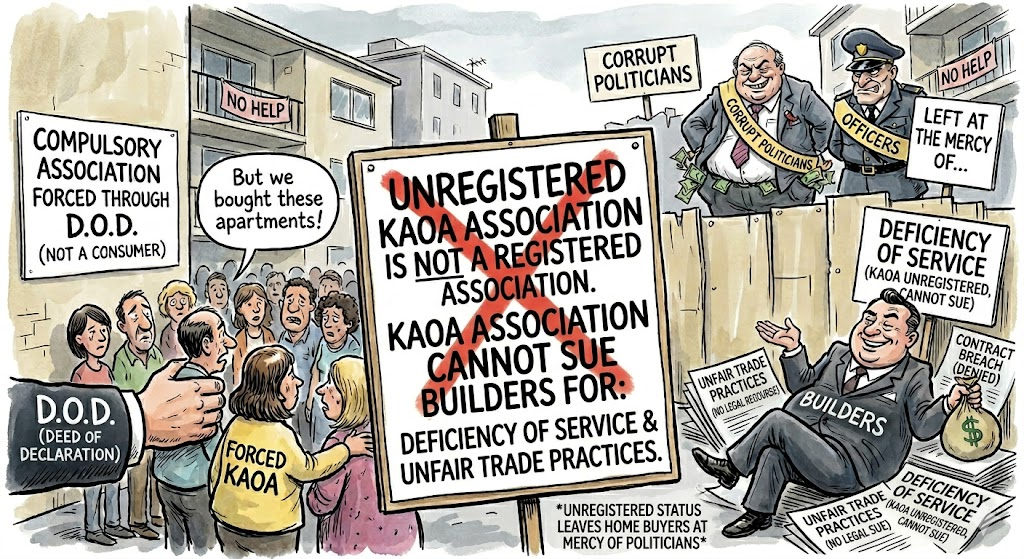
Formation of association has been recognized as the rights of the citizens. But the right to stay away from the association is also a right. In that case a forced compulsory non-voluntary association can not be included in the right since it is not exercised by the individuals. Then the next question whether an unregistered association has the legal capacity to sue or be sued goes to the root of civil jurisprudence concerning juristic personality. Indian law consistently maintains a distinction between the Recognized legal entities (companies and cooperative societies and other Unincorporated associations, which remain merely a collection of individuals. This distinction becomes critically relevant in the context of apartment associations formed in Karnataka under the Karnataka Apartment Ownership Act, 1972 (KAOA), where its non-voluntary, non-consumer, compulsory and unregistered nature has led to serious legal consequences in governance and litigation.
It is a settled principle that an unregistered association is not a legal person and has no independent existence apart from its members. For being identified as an entity with legal existence it should be registered with an identity of its own with a authority. Courts have repeatedly held that such bodies without registration:
- 👉🏽 Cannot own property in their own name
- 👉🏽 Cannot enter into contracts as a distinct entity
- 👉🏽 Cannot sue or be sued in their own name
Instead, they are treated as a mere aggregation of individuals who come together to meet their requirements. Further, even a registered society under the Societies Registration Act is often not treated as a fully independent juristic entity like a company or cooperative society and procedural requirements must still be satisfied for litigation. Procedural Mechanism envisaged vide the Order I Rule 8 CPC, is where numerous persons share a common interest, the law provides a procedural device under the provision of Order I Rule 8 of the Code of Civil Procedure, 1908 which provides for enabling, one or more persons to sue or defend, On behalf of a larger group or with court permission . However, this is not a recognition of the association as a legal entity, but merely a procedural convenience. Crucially, Order I Rule 8 does not create a right to sue; it only regulates how an existing right is exercised. Thus, if the association itself has no legal personality, it cannot derive one through procedural law. Judicial Position is clear as per the various judgements of Hon’ble Supreme Court & High CourtsThe Hon’ble Supreme Court in S.N.D.P. Sakhayogam v. Kerala Atmavidya Sangham (2017), emphasized, that maintainability must be examined at the threshold, Courts must determine whether the plaintiff has legal capacity to sue and representative suits cannot cure absence of legal status.
And the Hon’ble Bombay High Court, held in The Gorakh Hilal Patil vs Parit Samaj Seva Mandal on 21 July, 2011, that unregistered associations cannot maintain suits in their own name. The Suits must be filed, either by all members, or through representative capacity under Order I Rule 8 CPC. Cases across jurisdictions (Madras, Gauhati, etc.) have rejected suits filed in the name of unregistered bodies as not maintainable. From statutory and judicial analysis, an unregistered association has no locus standi to sue in its own name.It can sue only, through all its members collectively, or through representative suits under Order I Rule 8 CPC
The Karnataka Apartment Ownership Act, 1972, provides for declaration of apartments and not for formation of association and does not provide a clear statutory mechanism for incorporation or registration of the association as a legal entity. This creates a structural gap because such “association” remains unincorporated and it lacks juristic personality. In Sobha Hibiscus Apartment Owners Association v. M/s Sobha Developers Ltd, the Supreme Court observed, that the association formed under KAOA is not a registered body, it does not acquire independent legal status and therefore, it cannot sue in its own name. It is not a consumer and not a voluntary association.
This ruling reinforces the doctrinal position, KAOA associations are not legal entities, but merely a body of apartment owners.These associations under KAOA, cannot file suits against builders, cannot enforce contracts, cannot initiate legal proceedings in their own name
Practical Litigation Complications
There are serious implication involved with this kind of associations. Residents must File suits individually, which is life threatening for those individuals when they have to file cases against the powerful lobbies of the builders or this leads to, procedural delays, increased litigation costs and multiplicity of proceedings
Governance Impact
The absence of legal status affects the apartment association in many ways like
(a) Fragile Contractual Enforcement
- Agreements with vendors, maintenance agencies become legally fragile
(b) Property Mis-Management
- Common areas cannot be effectively litigated or defended
(c) Financial Operations
- Difficulty in enforcing dues or penalties
(d) Builder Accountability
- Weakens collective bargaining power against developers . Association can not sue the builder for any deficiency in service etc.
(e ) Legally Cannot open Bank Account
- Presently Bank accounts are being opened with the registration number of the DOD registration and not association registration. This is illegal.
Comparative Position
| Entity Type | Legal Status | Capacity to Sue |
| Company | Juristic Person | Yes (in own name) |
| Registered Society | Limited recognition | Yes (subject to procedure) |
| Cooperative Society | Juristic Person | Yes |
| KAOA Association | Unincorporated body | No (must sue through members) |
The legal vacuum under KAOA creates a contradiction within its own content and the law. The Act contemplates ownership rights. And it doesn’t speak about formation of any association to make it a legal personality of the collective body. This leads to, “Responsibility without legal capacity”. In contrast, statutes like, Cooperative Societies Acts and Companies Act explicitly confer legal personality, ensuring enforceability. The law is unequivocal in saying an unregistered association is not a legal entity, it cannot sue or be sued in its own name and it functions only as a collective of individuals. With reference to the KAOA Apartment associations they remain legally handicapped bodies. The Sobha Hibiscus judgment confirms their lack of locus standi. This severely impacts apartment governance, enforcement, and dispute resolution . To resolve this structural defect, only way is to form apartment cooperative society as in State of Maharashtra, Gujarat and other states.
Number of views: 1,976
(Written with Assistance of AI)