


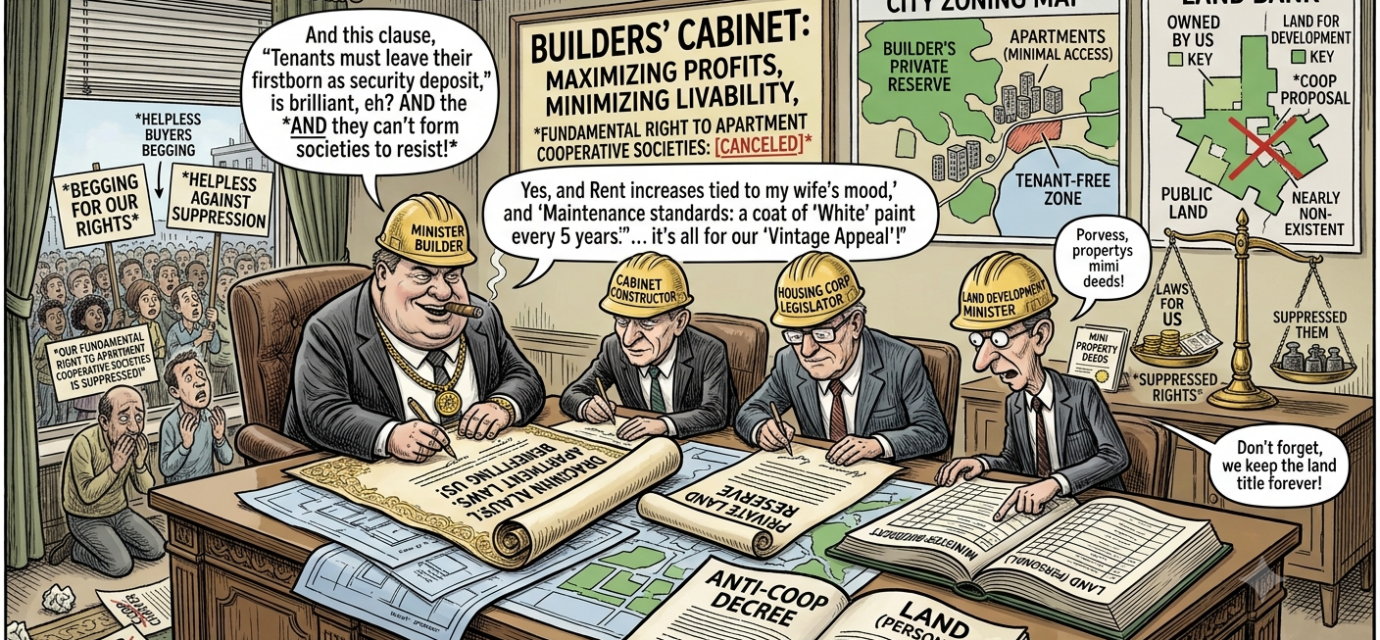










WHY UNREGISTERED ASSOCIATION OF KAOA? WHAT ARE ITS MOTIVES?

The Karnataka Apartment Ownership Act 1972 (KAOA) is an Act which came into force on 1st April 1975 with the stated object for providing the ownership, transferability and heritability and provide for connected matters. It is a well known fact that the ownership is achieved through the execution of the Sale Deed under the provision of the Transfer of Property Act 1808 and the Indian Contract Act 1872. Subsequently there is no requirement of any additional law to prove this. There are many apartments without this till date in India as well as in Bengaluru.
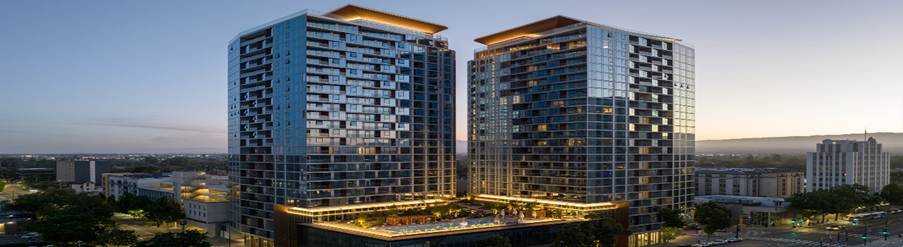
Courtesy: Sentral.com
It is necessary to consider whether there is any ulterior motive to enforce this additional law, compelling submission to its provisions while sacrificing the ownership rights granted by other laws. Legally, this law is not necessary at all.
Most importantly, the absence of this KAOA Act will help retain absolute ownership with the owners without surrendering the rights assigned under other laws.
The KAOA 1972 applies only to those properties where the sole owner or all the owners before sale of first flat subject their property to the provisions of this KAOA 1972 Act, thereby taking away all the rights granted under other Acts. The sole owner of the property of an apartment complex is the builder, according to Rule 3 of the KAOR 1975, which states that the Deed of Declaration must be executed in Form A. This form uses the term “grantor.” The word “grantor” refers to the sole owner in the case of an apartment complex prior to the sale of the first flat. This is confirmed by the usage of the words “will sell the flat” and “constructed and proposed to be constructed,” indicating that it is before the sale of the first flat. The grantor will be the developer and the owner of the land in the case of a joint development agreement. The word “property” includes both the building and the land. The “Form A” will be executed by the builder and all the landowners. Sometimes, it is only the builder if there is no joint development agreement. In Form A, they declare that they are the owners of the property, including the land and the building. No flat purchasers are included in the execution of the Deed of Declaration, as per the provisions of Section 2 and Rule 3 of the KAOR 1975.
Therefore, as per the above, the Deed of Declaration declares that the owners of the property and land—i.e., grantors 1 and 2—remain the perpetual owners of the property. Subsequently, only the flats are sold by the builder, as provided in Section 5, for the ownership of flats.
Rule 4 provides for the execution of a declaration in Form B. Rule 6 provides for the conveyance of flats to the flat purchasers by a Deed of Apartment. Here, there is no mention of the conveyance of land. Rule 7 of the KAOR 1975 provides for the Deed of Apartment, executed by the builder in the first part and the flat purchaser in the second part. In Form B, the flat purchaser declares that he or she is the owner of flat number so-and-so. This must be executed in the presence of a magistrate or any competent authority. In practice, this provision is not known to have been complied with to date by any apartment complex, with rare exceptions.
As per Section 13, all these documents must be registered in the sub-registrar’s office under the provisions of Section 13 of the Registration Act 1908. This section has been challenged in PIL 511/2021. A copy must then be submitted to the Registrar of Cooperative Societies.
Therefore, it is also confirmed that there is no registration of the association under this law.
This is made clear by the Registration Department in their written statement submitted to the Karnataka High Court in PIL 511/2021. Additionally, the Honorable Supreme Court has stated in its judgment in Sobha Hibiscus vs. Sobha Developers that this association is not a voluntary consumer association.
The Association is not a voluntary consumer association.
: Honorable Supreme Court of INDIA
After the execution of the Deed of Apartment, each apartment owner must sign Form B, declaring him or herself as the owner of the apartment. Because of the retention of the ownership with the builders it is learnt that some of the builders are mortgaging the land long after it is sold.
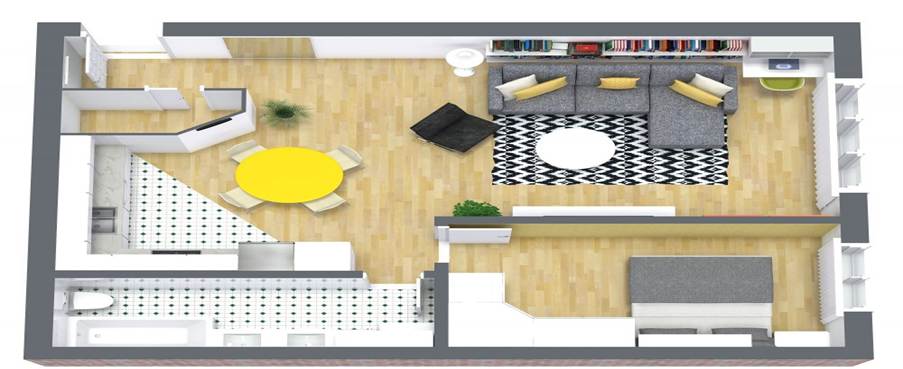
Courtesy:Room Sketcher.com
Therefore, the Act is applicable to the apartment complex if and only if the sole owner or all the owners have submitted their property to the provisions of the Act before the sale of flats. For the removal of the apartment from these provisions, all the owners need to give consent, which is an impossible task. When the apartment is removed from the provisions of the Act, the common area is also released from the provisions of the Act. Moreover, there is no provision in the entire Act to form any association at any time. However, the subject of the association is included in the bye-laws, which can pertain to any other association or society. Since it is not a consumer association, it cannot be considered a consumer to any service provider, such as electricity suppliers or banks, in compliance with the Supreme Court judgment
One more issue being wrongly raised is the residential and commercial use of the apartment. The KAOA 1972 includes both commercial and residential uses, as stated in Form A, paragraph 4 of the Act, which specifies that the ground floor will be used for commercial facilities. Twisting this statement, a few have misled the courts to believe otherwise. It is true that all the apartments are mainly used for residential purposes, as envisaged in Section 2 of the Act, which does not bar their commercial use, contrary to the misinterpretation by some
The association, formed without any provision under the KAOA 1972, remains an unregistered association. Registration is necessary for conveyance, collective ownership of the property on behalf of the owners, to be recognized as a consumer, and to represent in a court of law, among other things.
The KRERA Rule 2(b) also clearly states that the association to be formed must be registered. Rule 2(c) further specifies the cooperative society, meaning it must be a cooperative society only. It is also a fundamental right of the citizens of India to form a cooperative society under the provisions of the 97th Amendment of the Indian Constitution. Registration is essential to ensure conveyance to a juristic body, which the KAOA association is not. The issues with this type of association include uncontrolled elections and poor financial management. All apartment owners need to consider protecting their property, including the land, for their children and for future redevelopment
WE ALL KNOW ONCE WE RECEIVE THE OWNERSHIP THERE IS NO NECESSITY OF SURRENDERING TO ANY OTHER LAW.



-
-
-
-
-
-
-
-
-
Show CommentsThis article provides a deeply thought-provoking and detailed critique of the Karnataka Apartment Ownership Act (KAOA) 1972, particularly its practical application (or lack thereof) in present-day apartment governance. The points raised by Mr. Vidyadhar M Durgekar rightly question the necessity of compelling residents to comply with an additional framework—KAOA—when ownership is already firmly established through registered Sale Deeds under the Transfer of Property Act and the Indian Contract Act.
The central argument—that the KAOA may in fact dilute individual ownership rights and lacks enforceability without proper registration—is both compelling and legally sound. It is concerning that many associations function as “unregistered entities” under the guise of KAOA without statutory legitimacy, which could severely impact legal standing, service access, and future redevelopment rights.
Moreover, the article rightly highlights the ambiguities around Deed of Declaration and Form A execution, the exclusion of flat owners in the original declaration, and the lack of provision for forming a statutory association under the Act itself. This creates a vacuum that unregistered associations cannot legally fill.
The observations on KRERA and the 97th Constitutional Amendment further strengthen the argument—underscoring that only a registered cooperative society or a legal entity can hold collective ownership, represent owners, and enforce their rights in courts or administrative forums.
In a time when many apartment communities face mismanagement, lack of transparency, and legal vulnerability due to improperly formed associations, this article is a much-needed wake-up call. It reminds us that compliance with the right legal structure—like forming a registered cooperative society or an association under the Societies Registration Act—is essential not just for present-day functioning but also for long-term asset protection.
Thank you for shedding light on this crucial, yet often misunderstood, subject.
Sir. I am apartment owner in Bangalore . We have association which say DOD at sub registrar had provided them legal status. They even get their bye laws approved from comptent authority under KOA 1972. Even they are charging maintenance charges at Rs 5 sft . Highest in Bangalore for 6 acres Rise Appartment of 38 floor. Even they are charging CAPEX every year of Rs 1 lacs over and above CAM charges. CAPEX for builder incomplete work. Even they have no legal judgment to collect this money from residents but there is old group of residents which are in majority. Who did paid CAM Rs 1sft and electricity charges Rs 1000 per month for years. They had dispute due to it with builder . Now they want this CAPEX burden to be shared with new residents as well only by passing a bye law in EGM to stop the services of CAM payers if they did not CAPEX for builder work. Also this amendment is below 75% . As bye laws and amendments are never approved . They are calling non payers of CAPEX as defaulter and defame on various telegram and what’s group . Even put their names on Main security also on building notice boards. Worst they are stopping these residents minor children to play at Club house. Can such un registered association do this and trouble residents.
One of the best articale on this topic till date i read
Thought provoking article with a detailed deep insight on the subject.
It looks that deep studies have been made to draft the article with all the intricate points that are relevant to the present day scenario. Most of the times, people once after entering the flat never again look at the legal implications or property title aspects of the asset acquired. As a result, there are plethora of examples that weave a web of complications which later on generations hardly bother to entertain. As a result, there are cases, where the properties are sold in distress for the throw away prices and someone clever enough to understand the clear the legal impediments sheepishly acquires them and turns them into a real gold mine! This article will help people understand how to retain their legal titles. Bravo 👌👏…..keep it up.
Having bought an apartment myself i would very much like to say that many points mentioned in the article are not something I thought of or did the due diligence to understand. Main steps i went through were registration and down payment . For a layman like me this is truly an eye opener. Very well articulated !
Having bought an apartment recently there’s not much i delved into apart from down payment and registration . For a layman like me the minutiae’s of land ownership and different laws associated with it are explained in a great detailed manner . Great job in articulating this complex topic by the author!
Sir. I am apartment owner in Bangalore . We have association which say DOD at sub registrar had provided them legal status. They even did not get their bye laws approved from comptent authority under KOA 1972. Even they are charging maintenance charges at Rs 5 sft . Highest in Bangalore for 6 acres Rise Appartment of 38 floor. Even they are charging CAPEX every year of Rs 1 lacs over and above CAM charges. CAPEX for builder incomplete work. Even they have no legal judgment to collect this money from residents but there is old group of residents which are in majority. Who did paid CAM Rs 1sft and electricity charges Rs 1000 per month for years. They had dispute due to it with builder . Now they want this CAPEX burden to be shared with new residents as well only by passing a bye law in EGM to stop the services of CAM payers if they did not CAPEX for builder work. Also this amendment is below 75% . As bye laws and amendments are never approved . They are calling non payers of CAPEX as defaulter and defame on various telegram and what’s group . Even put their names on Main security also on building notice boards. Worst they are stopping these residents minor children to play at Club house. Can such un registered association do this and trouble residents.
1)How a land owning builder who constructs and sells the flat can be called as “Grantor”? Only those great Legal Pundits who formulated KAOA 1972(if they are alive)should tell.The term grantor gives the meaning of benefactor.Did they assume that the apartment seller(builder)is doing a favour to the apartment purchasers?
The KAOA 1972 is an appalling ACT that keeps the apartment owners permanently at the mercy of builder.
Those who wrote this act and made it in to a Law in 1972 appear to sanctify/approve this unequal relation and therefore they are calling the builder as ” grantor” and apartment purchasers as “grantee”